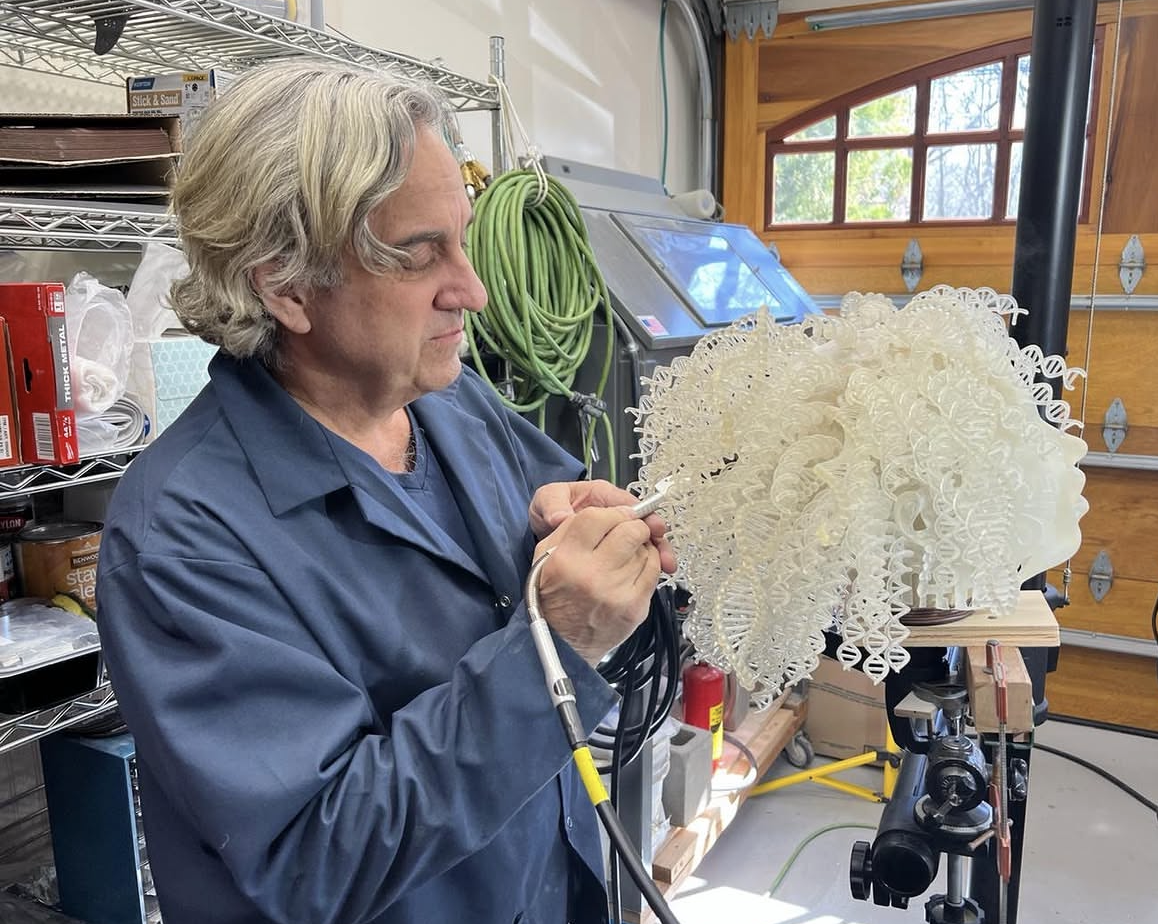
MICHAEL CARDACINO
ABOUT
I am still learning how to see.
Making the Invisible Visible
My work begins with a question, not a style.
I don't make sculpture to illustrate something I already know. Sometimes I don't even know what I'm looking for until I begin making it.
Making the sculpture becomes a way of looking at it more closely.
That may be why my work can look so different from one piece to another. I don't begin with a particular material or a recognizable style and ask what else I can make with it. I begin with the question and look for the form that might allow me—and perhaps someone else—to see it differently.
Sometimes the question is about identity. Sometimes joy. Sometimes emptiness, interdependence, authority, or the restraint of power. These things profoundly affect our lives, but they have no physical form of their own.
Sculpture gives me a way to bring them into the physical world.
But making something visible doesn't mean explaining it.
How Things Come Into Being
I've become increasingly interested in how we construct our understanding of ourselves and the world around us.
We develop identities, form beliefs, make judgments, and become attached to ideas about who we are and how things ought to be. Over time, these constructions can become so familiar that we accept them as reality, seldom questioning how they came into being.
I'm interested in what lies beneath these experiences—the influences, assumptions, and conditions that give rise to them.
Rather than simply expressing an emotion or a particular point of view, I'm interested in exploring how that emotion or viewpoint arises.
What are we not seeing about the way we see?
And what happens when we begin to recognize these processes at work? Can seeing how our perceptions and reactions arise change our relationship to them? Can recognizing the causes of our habitual responses open the possibility of responding differently?
The Seeds of a Sculpture
I don't think an artwork begins when I start making it. There are seeds that have accumulated over the years—things I've seen, people I've met, places I've traveled, questions I haven't resolved. Given the right causes and conditions, some come to fruition, while others pass away without the conditions they need to grow.
Making the work changes things too. A material creates a problem. Solving the problem reveals something I hadn't expected.
Someone sees the finished work and responds in a way I never anticipated. They may bring a history or experience quite different from my own and discover something I hadn't seen. I don't have to agree with every interpretation to learn from it.
Sometimes that encounter changes my understanding and becomes the beginning of another question. Each of those experiences becomes another seed.
So one work leads to another, sometimes years later and in ways I couldn't have planned. There isn't really a beginning or an end point. What comes to fruition creates new causes and conditions, new experiences and new seeds, and the process carries on.
The artwork comes from causes and conditions. Then it goes out into the world and becomes one of them.
Learning to See
The longer I've worked, the more interested I've become in the act of seeing itself.
We don't simply look at something and receive it as it is. We bring our histories, expectations, fears, desires, and assumptions with us.
Move around a sculpture and the relationships change. Something that was hidden appears. Something that seemed obvious from one position may look completely different from another.
No single point of view contains the whole thing.
I like that sculpture requires us to move. We have to change our position to continue looking. Perhaps that is also a useful way to encounter the world.
I don't expect a sculpture to provide an answer. If anything, I hope it slows us down long enough to notice something we hadn't noticed before—to look again, from another position, and perhaps see the question differently.