IDENTITY
INSTAGRAM WOMAN - MOMENT OF TRUTH
A sculpture about identity, attention and the self we construct.
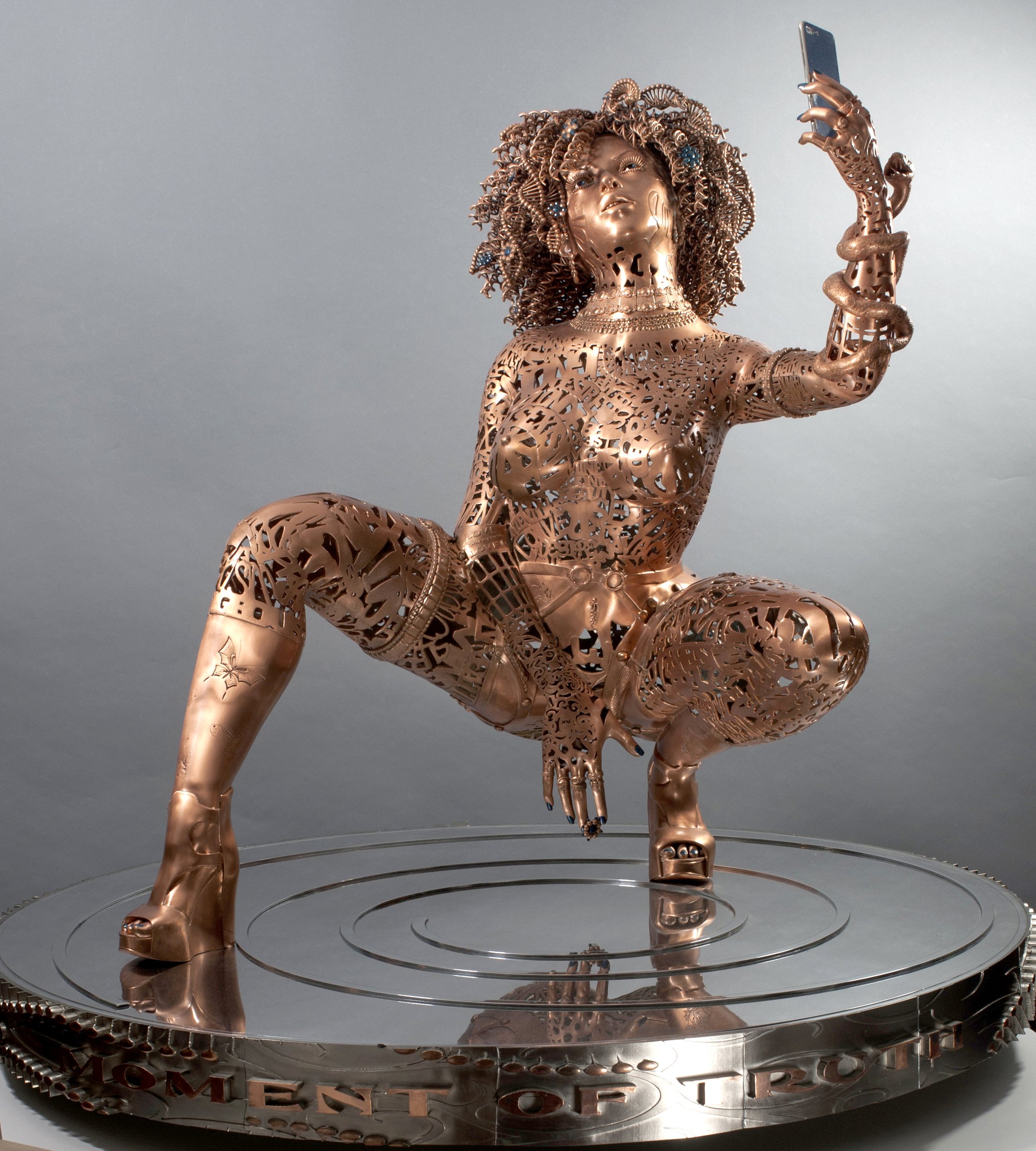
She presents herself to the phone. The device becomes mirror, audience and measure.
LIKE ME. LOVE ME. FOLLOW ME. WORSHIP ME.
A woman made of many women. We recognize her. We may even see ourselves in her. But who is she? And what makes us so certain of who we are?
THE SELF WE CONSTRUCT
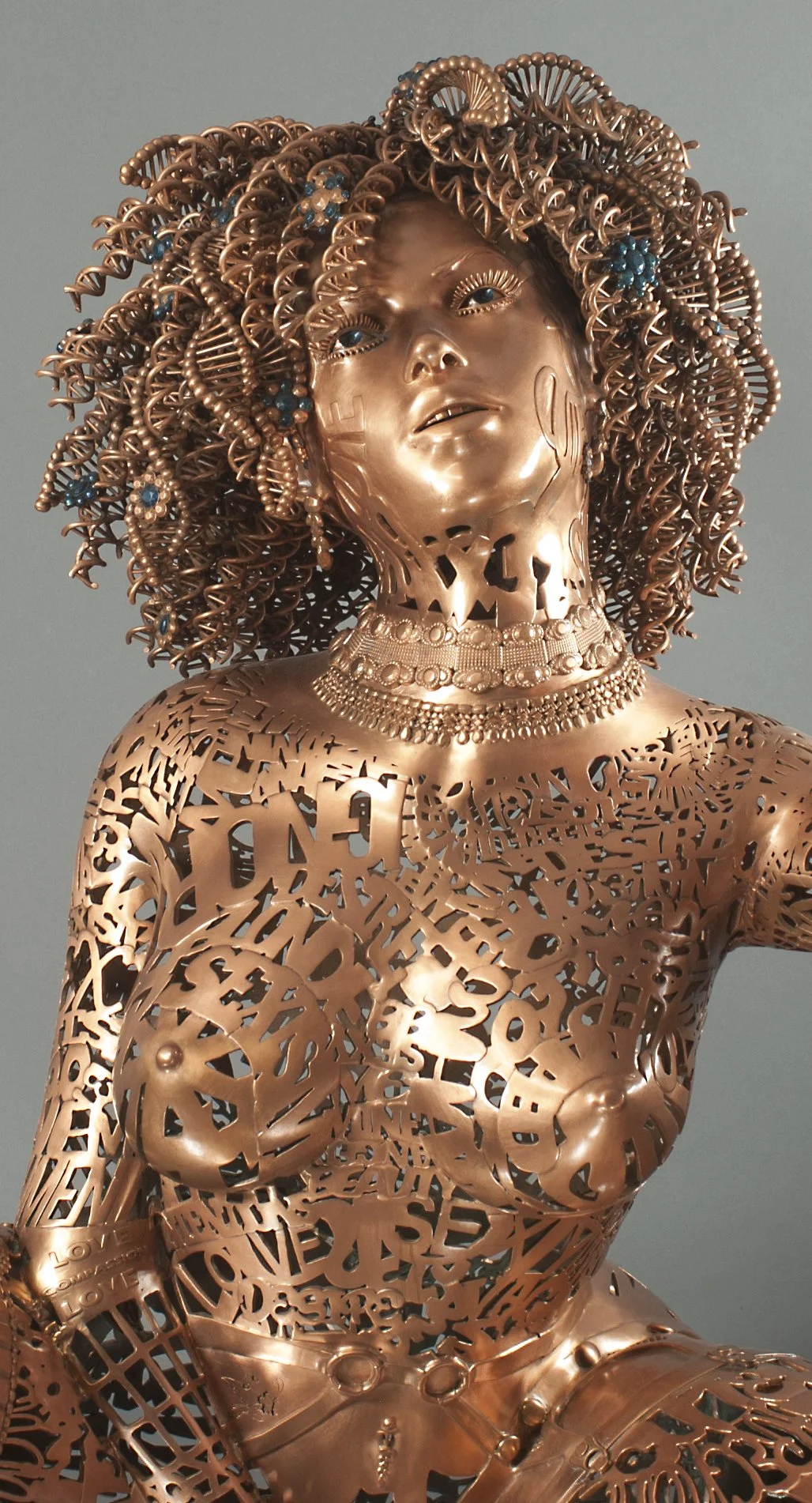
Her body carries words, symbols, ornament and cultural references. They suggest the identities we inherit, the identities placed upon us, and the identities we learn to construct for ourselves.
The figure appears richly present, yet she is physically open. Light and space pass through her. From a distance she seems complete; up close, the construction begins to reveal itself.
The question is not simply Who is she?
It is: what has gone into making the person she believes herself to be?
THE PHONE, THE SNAKE, THE GAZE
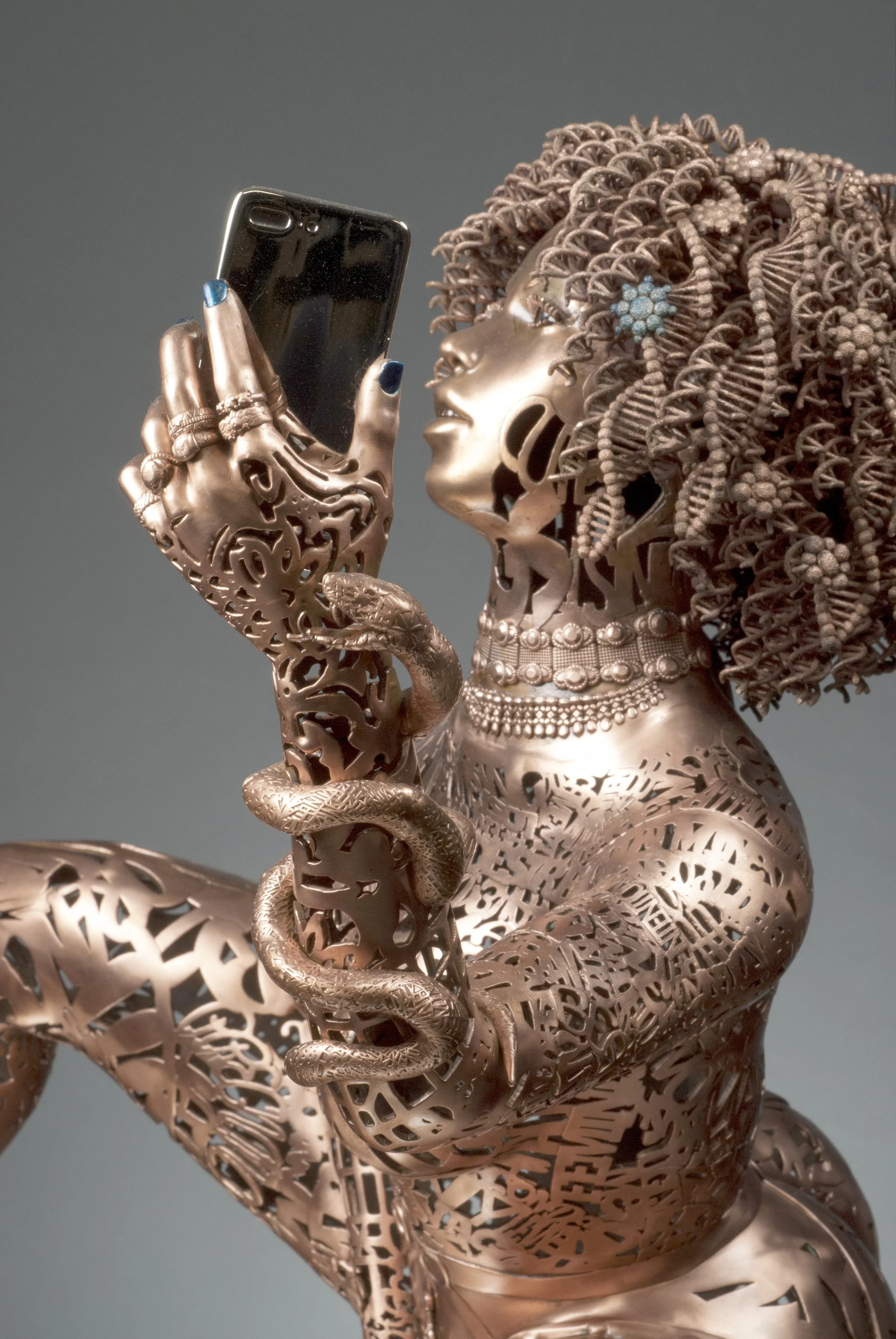
THE PHONE BECOMES BOTH MIRROR AND AUDIENCE.
The language is deliberately blunt. Approval becomes measurable. Attention becomes visible.
The snake coils around the arm that holds it. The device has not been thrown away. Liberation does not require the world around her to disappear. Something subtler has happened: her attention has moved.
THE FIGURE WAS BUILT FROM LANGUAGE
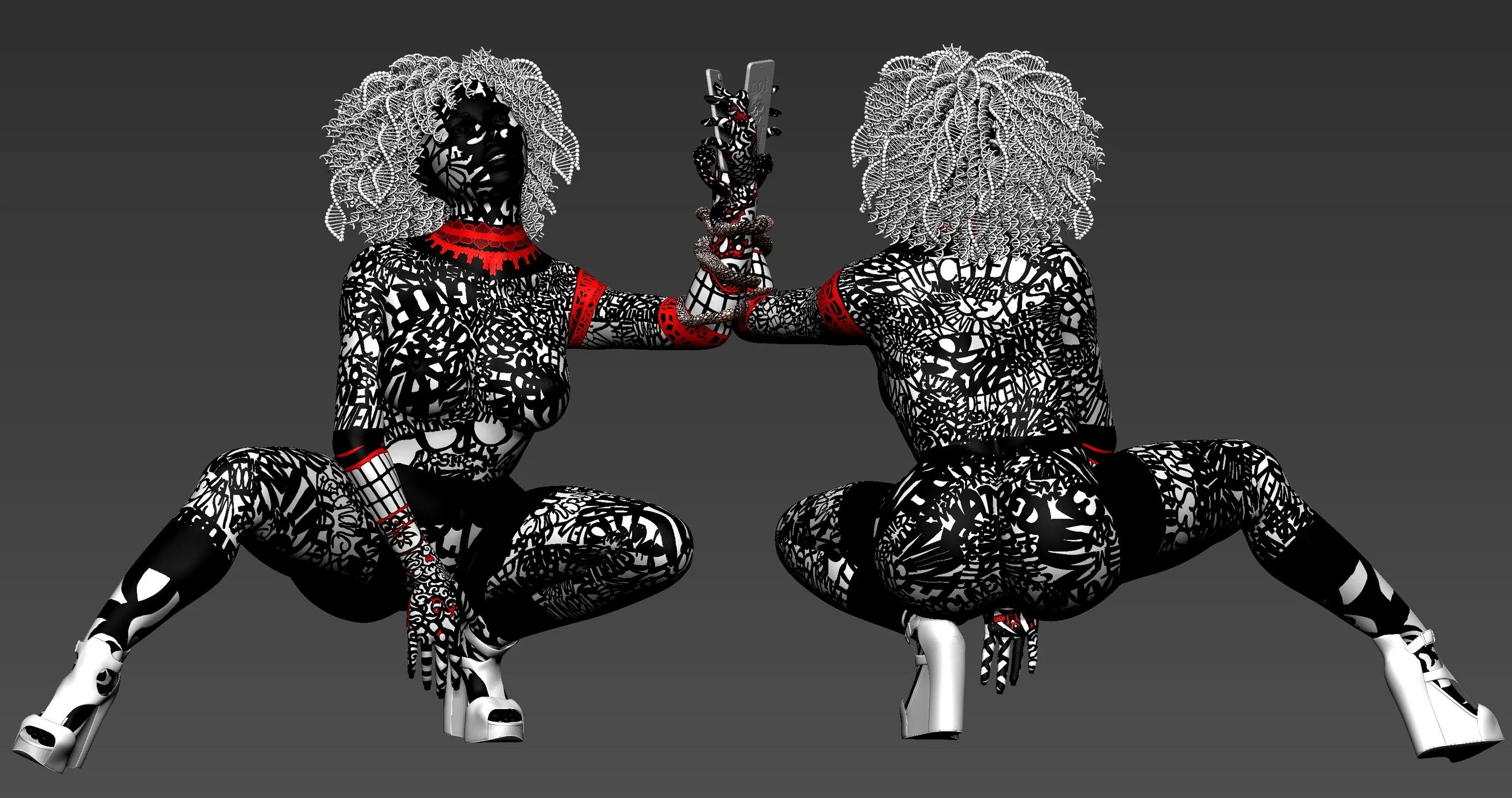
Digital development study - front and back
Before the finished copper, the digital figure reveals the underlying idea with unusual clarity: language does not sit on the surface. It constructs the body and continues around it.
This is a glimpse of the machinery beneath the seduction of the finished sculpture.
NOT SELF
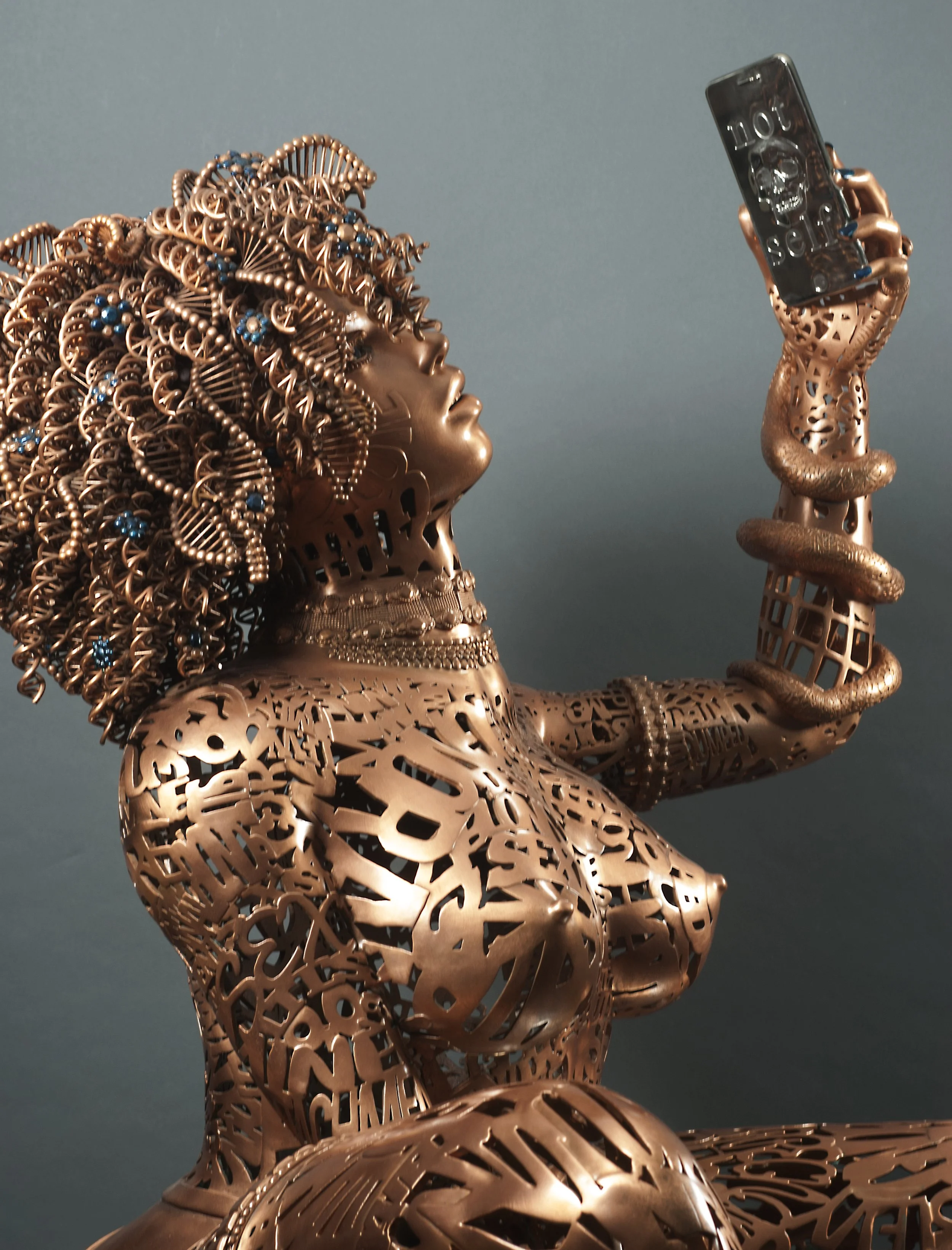
On the phone: NOT SELF.
The phrase is not an instruction to erase the person. It points toward a question running through the sculpture: how much of the self we defend as fixed and permanent has been assembled from memory, language, inheritance, judgment, desire and the gaze of other people?
FROM FACE TO CONSTRUCTION
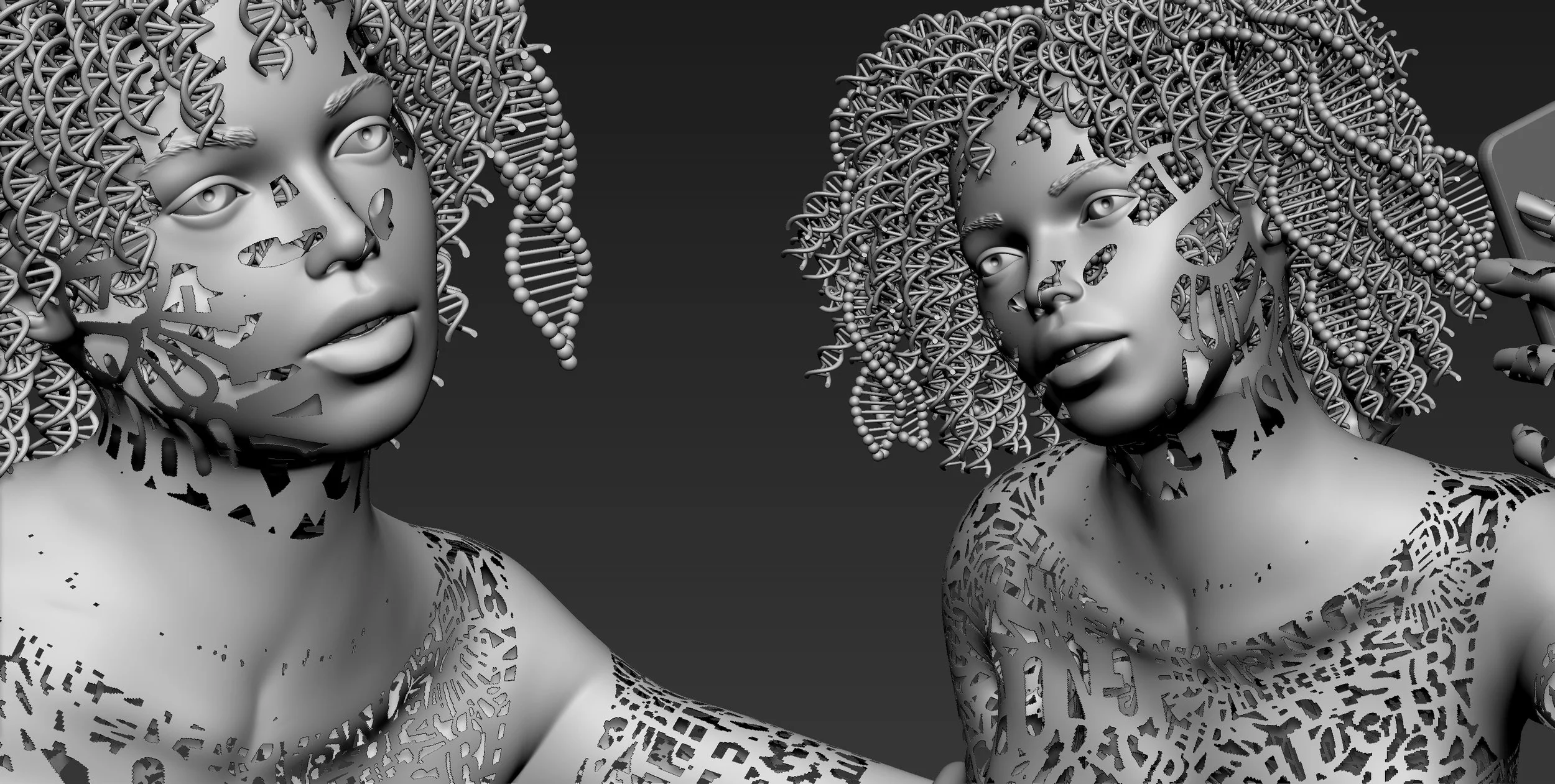
Digital development study
In the development of the figure, the recognizable human face remains present while openings, language and inherited structures begin to interrupt it. The person is still there. What changes is our ability to see how much has been added to the idea of who she is.
WHAT WE INHERIT
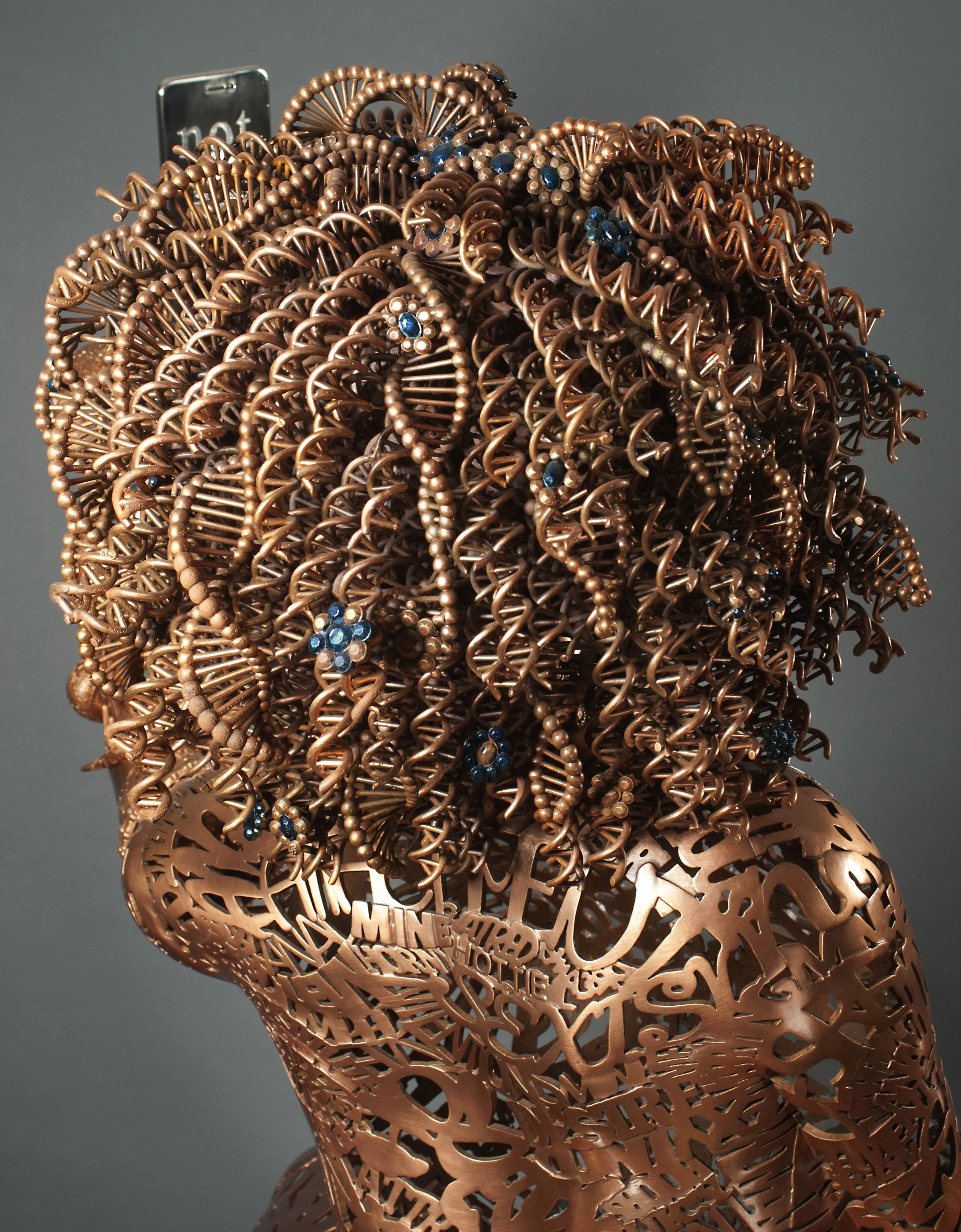
The elaborate hair rises into helix-like structures. It suggests inheritance - biological, cultural and historical - carried into the present and woven into the person we become. The words and markings across the body operate in a similar way. They are not simply decoration. They make visible the accumulation of influences that can settle onto a person until description begins to feel like identity.
GESTURE, ADORNMENT, CONSTRUCTION
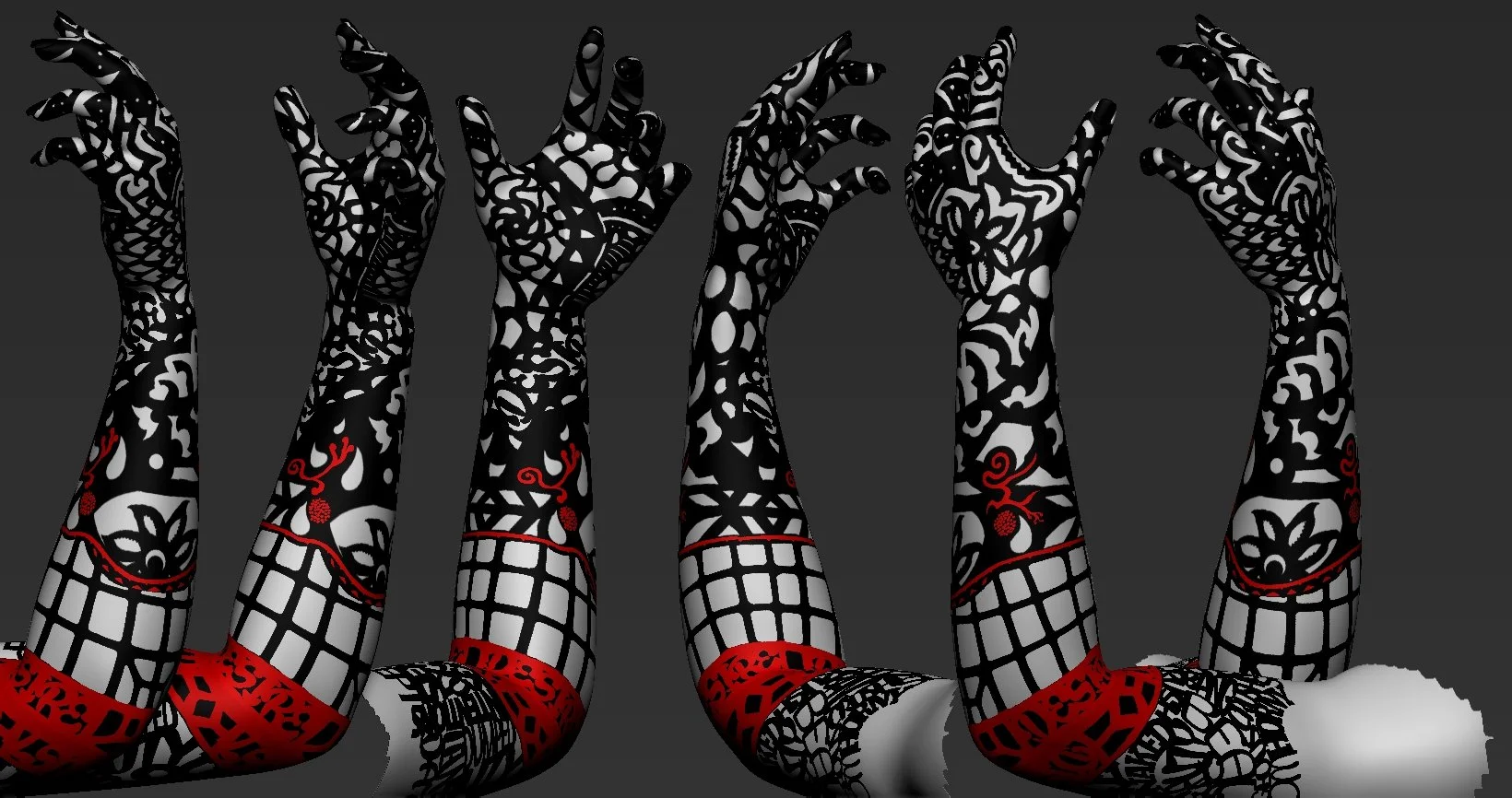
Digital hand and arm development study
The gestures, ornament and surface vocabulary were worked out as part of the figure's construction. Even the hand that presents the phone participates in the language of the body. This remains supporting material - a glimpse into the making rather than a competing image of the finished sculpture.
BUILT IN THE ROUND
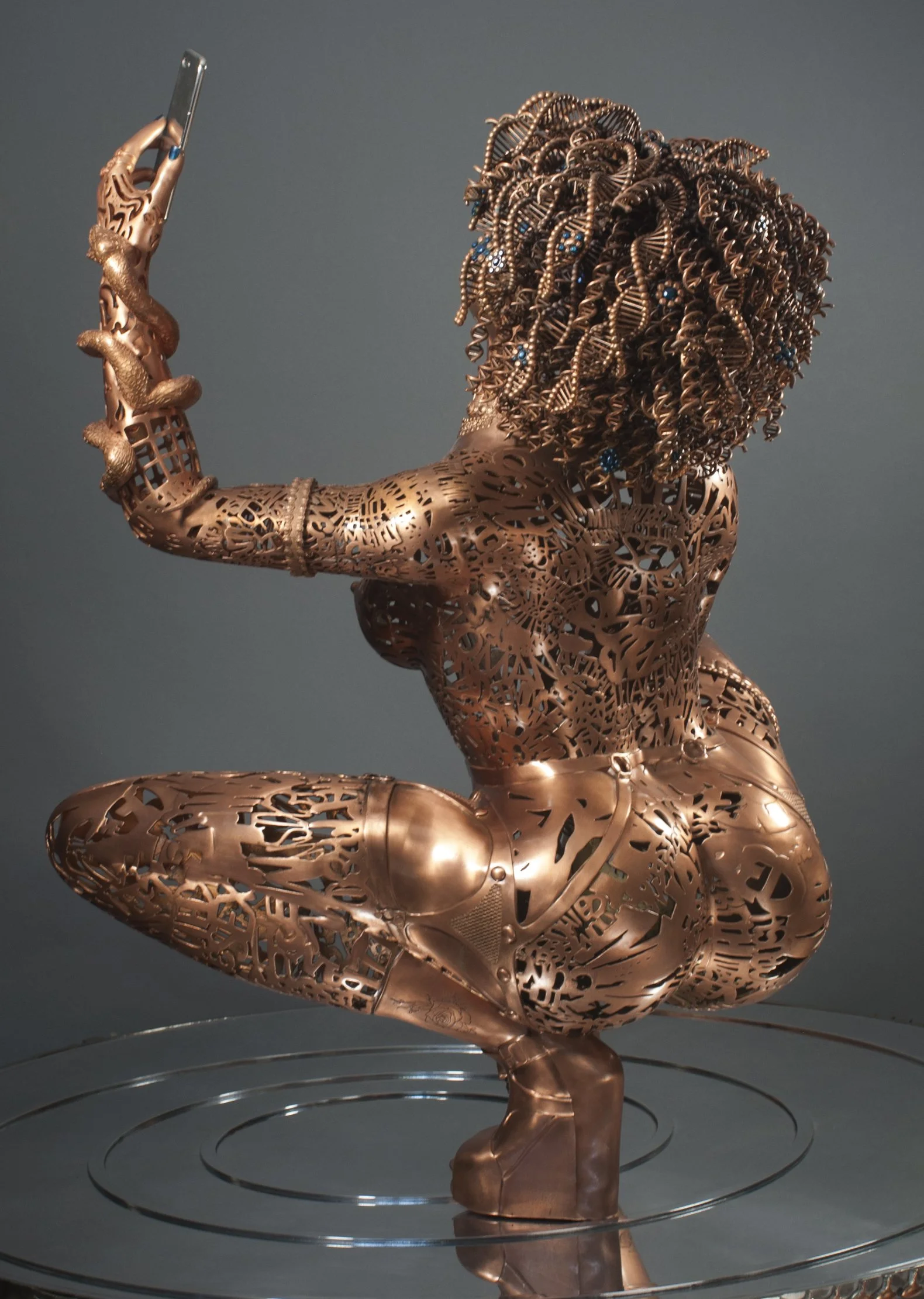
Seen from behind, the sculpture confirms that this is not a surface effect. Language, openings and structure continue around the body. Identity has been built in the round.
MOMENT OF TRUTH
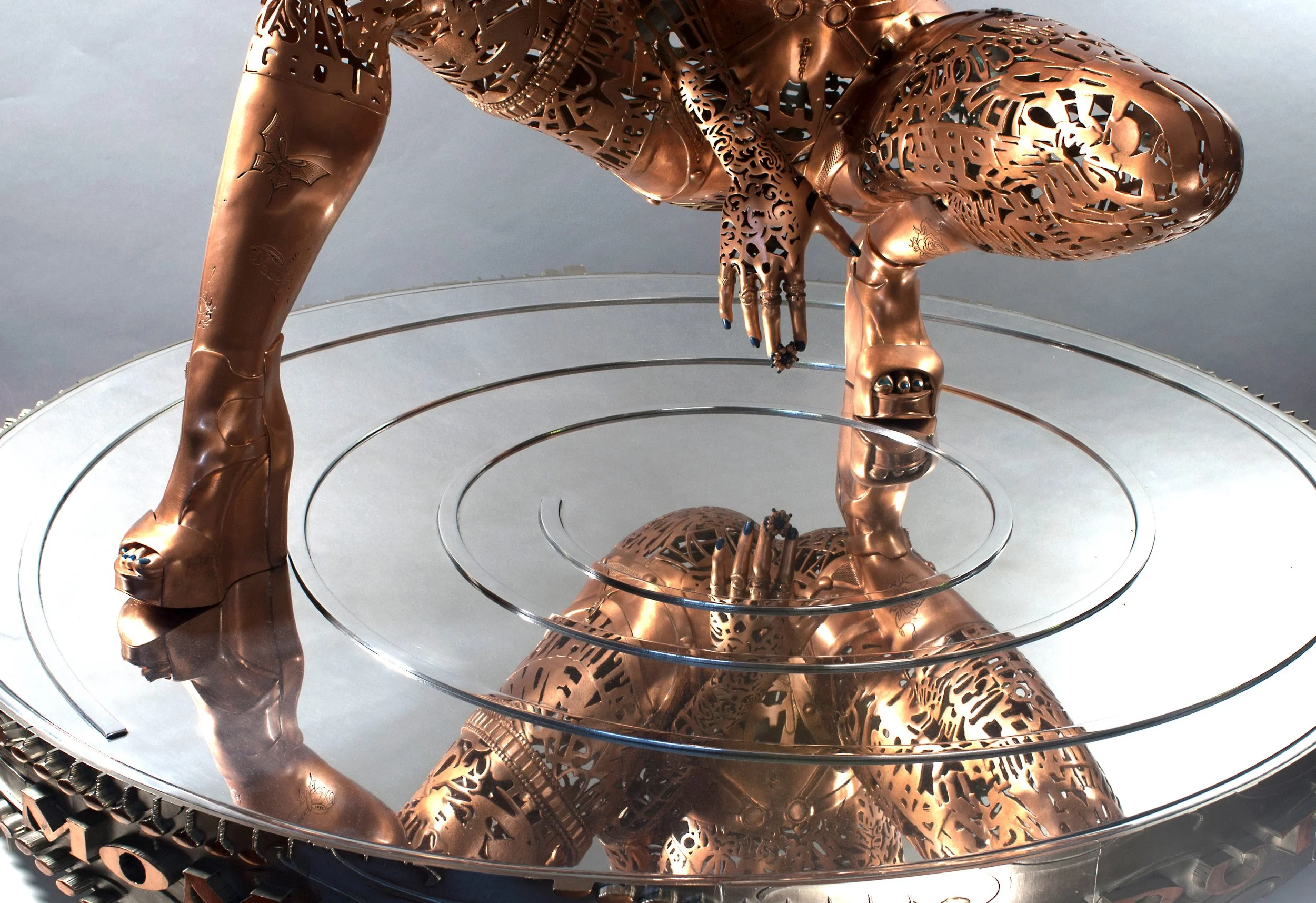
The concentric rings and reflected figure extend the question below her. The physical body, its image, the words and the surrounding space occupy the same field.
Her moment of truth is the moment she looks away.
The phone remains in her hand, but no longer holds her gaze.
That is the moment she is liberated.
The sculpture does not provide an answer. It makes the construction visible.

WHEN SOMEONE RECOGNIZES HERSELF
One of the most interesting things about showing Instagram Woman is discovering how differently people respond to her. I made the sculpture, but I do not get to decide what everyone sees in her.
The Clubhouse - almost a year earlier
A young white woman encountered a smaller version of Instagram Woman at The Clubhouse in East Hampton. She looked at the sculpture and said to me:
"This is very profound. I am that woman. This has hit me hard."
I was deeply moved. She wasn't simply admiring the sculpture. She recognized herself in it.
The HUB - nearly a year later
A young Black woman came up to me after seeing the larger sculpture. She spoke about the portrayal of a Black woman, the pressures of social media, and the exhausting effort to become someone acceptable. What she saw was a woman freeing herself from that struggle, even if only for a moment.
The two women had never met. They saw different versions of the sculpture at different exhibitions, almost a year apart. Yet each found something of her own life in the work.
I made the sculpture. I couldn't have made those women see what they saw. They brought their own lives to it.
AM I THE IMAGE I CREATE?
Celeste Marie looked closely at the fragmented body, the helix-like hair, the sexuality and the phone. She connected ancestry, desire and the performance of identity on social media. Then she asked:
"Am I expressing myself through this image or have I mistaken the image for myself?"
- Celeste Marie
She saw the possibility that the image we construct for an audience is not the entirety of who we are. What began as a woman taking a selfie became a question about the nature of self.
A woman made of many women. We recognize her. We may even see ourselves in her. But no single woman exists behind the image.
Who is she? And what makes us so certain of who we are?
A RESPONSE THAT STAYED
Celeste Marie returned to the sculpture with another observation:
"Your sculpture truly moved me and stayed on my mind long after I saw it."
- Celeste Marie
Her first comment asked whether an image can be mistaken for the self. Her second reminded me that an encounter with a sculpture can continue long after the viewer has walked away.
That is something I could never have designed into the work.
It happens between the sculpture and the person standing in front of it.